What’s Past is Prologue
During the COVID shutdown, I had the opportunity to make a virtual presentation to a group of young leaders at my company, Xcel Energy. The purpose of the presentation was to introduce these up-and-comers to the inner workings of the company and provide them with a practical understanding of how the company delivered energy to customers and value to shareholders. At the time, I was responsible for strategy, resource planning, communications, federal governmental affairs and public policy, and I found that summarizing all that in a presentation was both impossible and impossibly boring. So instead I decided to speak about leadership.
Why leadership? Well, obviously, it was a leadership class, so the folks in the room were probably more interested in leadership than in writing press releases or lobbying tax policy. The breadth of my job gave me a unique position to observe leaders in action, whether in Congress, governors’ mansions, or boardrooms. I thought that the class would appreciate hearing about successful leaders in the real world.
But almost immediately, I came to understand that teaching leadership was not for the faint of heart. The concept is hard to define, and the attributes of a good leader are extraordinarily broad and diverse. In the face of such a challenge, I started to wonder if it might be easier to talk about the details of the 45Q tax credit after all. (Actually, the energy nerd in me thinks that 45Q is really is interesting. Look it up.)
For me, the solution to this problem was found in the leadership examples from the past. The best way to understand leadership is to look at leaders - and thinkers - who came before us.
Which brings William Shakespeare into the picture. Shakespeare had one of the great minds in human history. Harold Bloom said that Shakespeare was “almost too vast to apprehend.” Through his work, it is clear that Shakespeare thought deeply about history, politics, love, life, death and - yep - leadership.
I have loved Shakespeare since high school, so Shakespeare became my “in” for my presentation on leadership. I’m not sure I gave the team what they wanted, but Will carried me through. When it was over, the moderator of the session told me that, “Now you can write your book.”
For the years that followed, that statement haunted me like Banquo’s ghost at dinner with Macbeth. Maybe I was on to something. When I retired five years later, I still thought about it, and started writing.
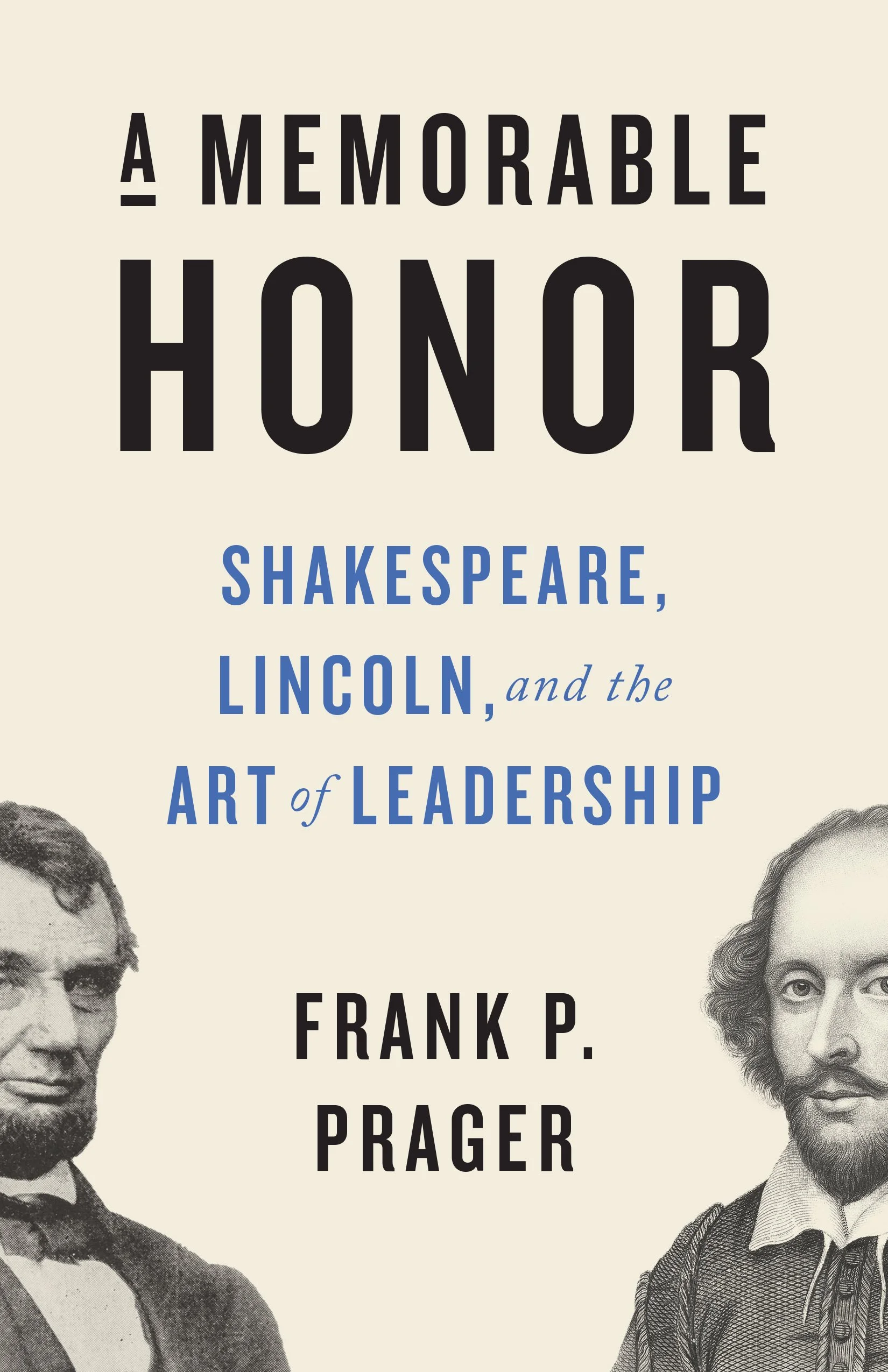
The resulting book was very different than I first imagined, but I’m proud of it. It’s called A Memorable Honor. I hope you’ll enjoy it. Preorder today!
