The poet’s eye, in a fine frenzy rolling, Doth glance from heaven to Earth, from Earth to heaven.
Last week, I had the chance to go to the Colorado Shakespeare Festival on the campus of the University of Colorado-Boulder and see two of Shakespeare’s best plays: Twelfth Night and Julius Caesar.
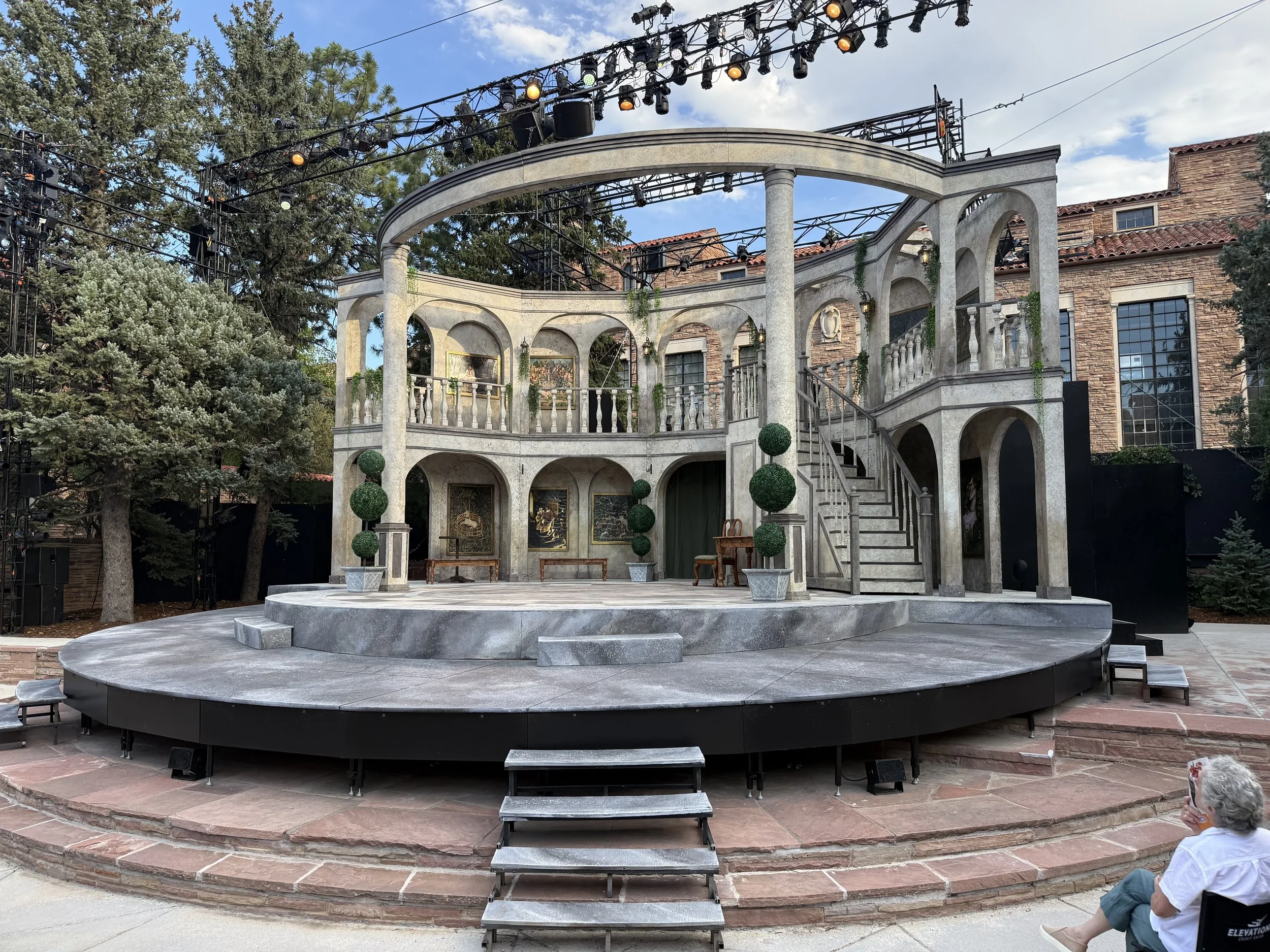
Twelfth Night is being staged under the stars on campus at the recently renovated Mary Rippon Theater. Here’s a picture of the stage for the production:
The production was terrific from the opening line, spoken by Duke Orsino: “If music be the food of love, play on.” This line is one of the greatest example of Shakespeare’s use of iambic pentameter. The line has a rhythm: each two-syllable “foot” includes an unstressed syllable and a stressed syllable: duh-DUM. There are five feet in each line (thus the name “pentameter”). If you say it out loud, overstressing the second, fourth, sixth, eighth and tenth syllable, you can hear this rhythm.
At the performance in Boulder, the actor playing Orsino (Brandon Carter) opened the play with “If music be the food of love…,” and then invited to audience to finish the line with “Play on!” That bit of fun only works with an audience full of Shakespeare nerds, but I resemble that remark, so it worked on me.
Why did Shakespeare write plays in verse, iambic pentameter in particular? There’s something remarkable about the use of poetic structures in language. They touch people in their minds and souls. Iambic pentameter, for example, uses a meter that evokes the human heartbeat: duh-DUM, duh-DUM, duh-DUM. We react to that meter because it sounds like the beating of our own hearts; in other words, it sounds like life.
Thanks to Christopher Nolan and Matt Damon, this is the summer of The Odyssey. Of course, The Odyssey doesn’t need a book adaption to help market the movie: it was first written 2700 years ago, allegedly by a blind poet named Homer. But in fact, The Odyssey was an oral poem that had existed for about 500 years before Homer put pen to paper. It was recited or sung by bards who told (and embellished) the story for centuries. These bards needed the rhythm and rhyme of poetry to help them remember such a massive work, and the poetry they used made their story compelling for their audiences.
The Odyssey was recited in a meter known as “dactylic hexameter.” I wouldn’t attempt to explain that meter in a blog post, mostly because I don’t speak ancient Greek, but apparently, it’s ideal for the language of the day. Iambic pentameter, the rhythm of Shakespeare, works much better for English. Indeed, Emily Wilson’s recent translation of The Odyssey, which helped inform Nolan’s film, is written in iambic pentameter.
Are you still with me? If this be madness, yet there is method in it: one of the things that Shakespeare teaches leaders is that nobility, honor, and inspiration come in part through the techniques and language of poetry. We live in a prose age, and no leader is going write a sonnet to his or her people. As I wrote in A Memorable Honor, a tax lawyer who files a brief in tax court filled with rhyming couplets will soon be out of a job. But, in the right moment and in the appropriate form, meter and rhythm, repetition and alliteration, and the other poetic devices can help move people to follow a leader’s vision.
Just ask Abraham Lincoln. The Gettysburg Address, perhaps the greatest speech in American history, is a short bit of prose that bursts with poetry. Lincoln used that speech to do something extraordinary – redefining and reinventing American democracy – something impossible but for the Shakespearean poetry that he hid in every line.
You can learn more about how poetry is tied to leadership in A Memorable Honor: Shakespeare, Lincoln, and the Art of Leadership, to be published on September 15.
Until next time.
Frank
P.S. If you haven’t done so, please add your name to the “Who Art Thou” link below to receive updates as we get closer to the September 15 publication of A Memorable Honor: Shakespeare, Lincoln and the Art of Leadership.
P.P.S. I’m pleased to announce that A Memorable Honor is an Amazon best seller and a hot new release! Preorder today!
