Mortal and unsure
One of the great things about having my own website is that I can subject you, dear reader, to my vacation photos without having to take the time to create a PowerPoint slide show or bribe you with alcohol. This week I’m on vacation with my wife Kim in Italy. We’ve spent a few days in Rome and are now about to head to points beyond.
In light of this, I kinda wish that I had saved my post about Rome for this week, but that’s the way the empire crumbles. Speaking of crumbling, look at this picture:
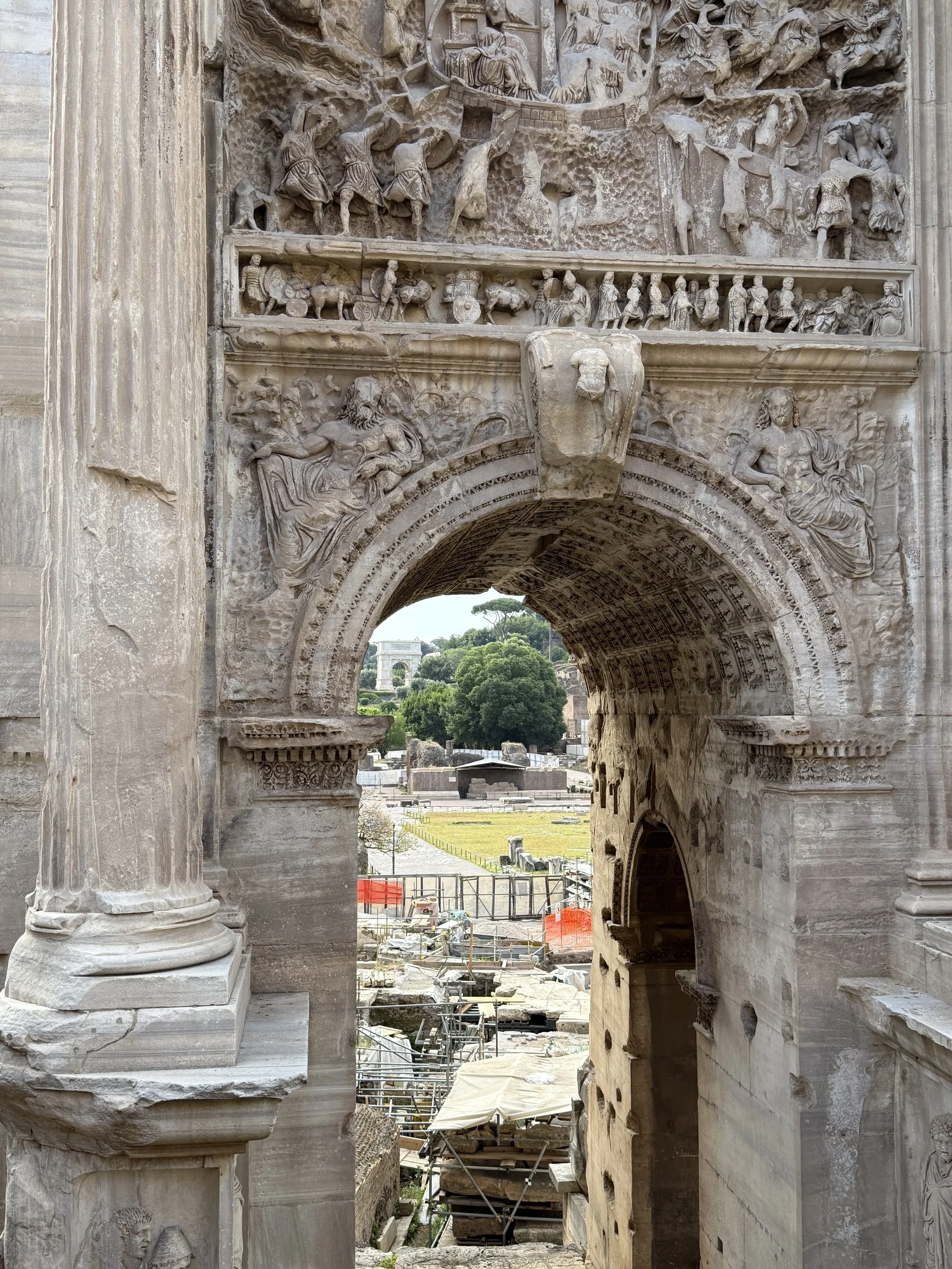
That’s the Roman Forum as seen through the Arch of Septimius Severus, the Emperor who, after a bit of upheaval, followed the lamentable Commodus (who you may remember was played by Joaquin Phoenix in Gladiator). In the distance, you can see the Arch of Titus, named for the Emperor who put down the Jewish Revolt in 70 AD and destroyed the Temple in Jerusalem.
Shakespeare wasn’t really interested in that time period. He was focused in the middle of the picture, just beyond the construction in the foreground, where you can see the Temple of the Divine Julius. That’s where Julius Caesar’s ashes were interred after he was deified by the Roman Senate. Caesar’s deification was the direct result of his assassination, something Shakespeare found ironic: in Julius Caesar, one of Caesar’s assassins, Cassius, made much of Caesar’s very human fallibility before the knives came out
The late Paul Cantor taught Shakespeare and politics for years at Yale, and he believed Shakespeare had a scholar’s understanding of Roman history and culture; Cantor compared Shakespeare’s political insights to Machiavelli and Nietzsche. As I said in an earlier post, Shakespeare believed that Caesar’s assassination was the hinge of Roman history and one of the most significant moments in human history.
Shakespeare’s Roman plays contained lessons about the challenge of maintaining a republic, something important to us today. But for leaders especially, Shakespeare’s Rome also provides insights on courage, wisdom, and memory that still echo.
But my visit Rome also brought to mind another of Shakespeare’s plays, one that has nothing to do with Rome itself. In the most famous lines from Act 5 of The Tempest, the wizard Prospero questions the very nature and permanence of reality:
The cloud-capp'd towers, the gorgeous palaces,
The solemn temples, the great globe itself,
Ye all which it inherit, shall dissolve
And, like this insubstantial pageant faded,
Leave not a rack behind. We are such stuff
As dreams are made on, and our little life
Is rounded with a sleep.
The ruins of Ancient Rome are extraordinary, but they are just that: ruins. Rome no longer bestrides the world. Its cloud capped towers, solemn temples, gorgeous palaces and the rest truly have dissolved. Prospero - Shakespeare - would say that nothing is permanent, and everything disappears - if it ever was real to begin with.
There is much philosophical hay to be made here, but for leaders, the story is this: If Rome can fade into rubble, so can all that you build and strive to create. In this fragility, there is something true, something that, if recognized, can paradoxically make leaders better and stronger.
That’s one of Shakespeare’s greatest leadership insights, one that I hope you will find in A Memorable Honor.
Until next time, I’m going back to drinking Chianti.
Frank
P. S. If you haven’t done so, please add your name to the “Who Art Thou” link below to receive updates as we get closer to the September 15 publication of A Memorable Honor: Shakespeare, Lincoln and the Art of Leadership.
